Destination-worthy public gardens of New England.
By Kelly Chase
New England’s gardens are far more than pretty backdrops; they are living museums shaped by dedicated gardeners and botanists. Many pair seasonal blooms with curated events and workshops, and all provide a peaceful escape. From hidden trolls to native plant sanctuaries, these New England gardens are worth weaving into any well-planned route.
Maine
Coastal Maine Botanical Gardens
105 Botanical Gardens Drive, Boothbay, ME | mainegardens.org
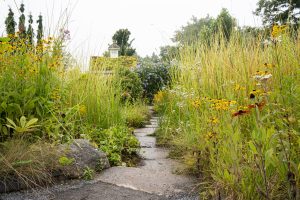
Located in Boothbay, Coastal Maine Botanical Gardens blooms along nearly a mile of tidewater shoreline. Of its 300 acres, 17 acres are dedicated to native plants of Maine and other species that thrive in the coastal climate. For families, the gardens offer a world of wonder, including a children’s garden inspired by local authors, a butterfly house, and a whimsical fairy village.
The staff’s dedication to education and art is visible at every turn: from the apiary and native bee exhibits to the world-famous Guardians of the Seeds—five towering trolls made from recycled materials by Danish artist Thomas Dambo.
Curated events take place throughout the year, with a robust summer schedule featuring programs like Food and Medicine of the Wabanaki for adults and interactive photography workshops for youth.
Land & Garden Preserve
Asticou Azalea Garden, Asticou Road at Route 198, Northeast Harbor, ME; Thuya Garden, Thuya Drive, Northeast Harbor, ME; Abby Aldrich Rockefeller Garden, Peabody Drive, Seal Harbor, ME (By reservation only) | gardenpreserve.org
On Mount Desert Island, the Land & Garden Preserve encompasses 1,400 acres of gardens and historic landscapes that honor the island’s Gilded Age legacy. Visitors can explore the Japanese-inspired Asticou Azalea Garden, home to rare specimens from designer Beatrix Farrand’s estate, or the hillside English borders of Thuya Garden, which is reached via a scenic switchback trail off the harbor.
Open on a limited basis, the Abby Aldrich Rockefeller Garden is home to a “Spirit Path” of Korean tomb figures; this walkway leads visitors toward an iconic moon gate framing a bronze Buddha. For those seeking a wilder experience, the Little Long Pond has winding carriage roads, open meadows, and a few coastal swimming spots for people and pets to enjoy.
Wild Gardens of Acadia
Sieur de Monts Spring, Acadia National Park, Bar Harbor, ME | nps.gov
The Wild Gardens of Acadia nestled within the Sieur de Monts Spring area of Mount Desert Island are just an acre in size, yet they serve as an educational guide to Acadia’s diverse ecosystems. In a small area, volunteers have curated 400 native plant species, organized into 13 distinct habitats from mountain bogs to stony beaches. This “miniature Acadia” serves as a living field guide, allowing visitors to experience the park’s entire botanical landscape on a single accessible stroll. While more compact than other Maine botanical destinations, this garden serves as a practical primer for hikers and can be a useful first stop, providing a “botanical cheat sheet” to help identify rare wildflowers and unique mosses found along the park’s more rugged trails.
New Hampshire
Fuller Gardens
10 Willow Avenue, North Hampton, NH | fullergardens.org
Fuller Gardens is smaller than its Maine counterparts at approximately three acres; nonetheless, this seaside garden is still worth a trip. It was designed in the late 1920s by Arthur Shurtleff and the Olmsted Brothers. The property is now managed by a nonprofit and has beautiful, unobstructed views of the Atlantic Ocean. Walking through the grounds, visitors can explore the formal rose gardens, which boast over 1,700 bushes and 125 varieties that bloom from June through October. The estate also features traditional English perennial borders, a tropical and desert conservatory, and a peaceful Japanese garden complete with a koi pond and wisteria.
Bedrock Gardens
19 High Road, Lee, NH | bedrockgardens.org
Bedrock Gardens is not a historic property built by a titan of industry; instead, it is a former dairy farm in Lee, New Hampshire, that serves as a testament to personal passion and perseverance. Over the course of 40 years, two creatives, artist Jill Nooney and her husband, Bob Munger, transformed the abandoned landscape into a 20-acre “living piece of art” for the public to enjoy.
Described by the Boston Globe as “Sissinghurst meets Dr. Seuss,” the gardens blend high-level horticulture with hundreds of sculptures crafted from salvaged machinery. As visitors explore the grounds, they find features like the Wiggle Waggle water rill and the Fibonacci-inspired Spiral Garden. Now a public nonprofit, Bedrock Gardens is both playful and inspiring to visit.
Vermont
Shelburne Museum
6000 Shelburne Road, Shelburne, VT | shelburnemuseum.org
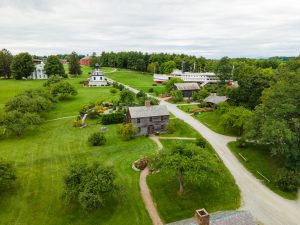
The Shelburne Museum is best known for its 39 historic buildings that house 150,000 works of American folk art and impressionist paintings. However, the museum’s 45-acre landscape should not be overlooked, as it features over 20 distinct gardens that tell the story of Vermont’s diverse horticulture.
The museum is home to one of the most significant collections of lilacs in the country, with 400 bushes that bloom in the spring. Visitors can wander through the Apothecary Garden and make their way to the Peony Garden, perhaps stopping for a ride on the 1920s carousel. During the summer months, they host live music events and offer daily demonstrations that bring the property’s history to life; visitors can watch a blacksmith and a printmaker work in their historic shops.
Hildene
1005 Hildene Road, Manchester, VT | hildene.org
Perched in Manchester, Vermont, Hildene is the 412-acre estate of Robert Todd Lincoln, President Abraham Lincoln’s son, as well as an American businessman and lawyer. Outside of the Georgian Revival mansion, a Stained-Glass Garden, which was designed by Robert Todd Lincoln’s daughter, resembles a cathedral window of peonies. June is a good time to visit as more than 1,000 peony plants burst with color.
Beyond the historic mansion, visitors can explore a solar-powered goat dairy, observatory, 1903 Pullman railcar, and 12 miles of scenic trails. There are educational events throughout the year including botany-focused discussions that teach tree pruning and microgreen tutorials.
Path of Life Sculpture Garden
36 Park Road, Windsor, VT | artisanspark.net
The Path of Life Sculpture Garden spans 14 acres bordering the Connecticut River in Windsor, Vermont. Created by a child and family therapist, the landscape serves as a soulful journey through 18 “rooms” featuring large-scale sculptures. These spaces are meant to represent the stages of the human spirit from Birth and Adventure, which has an 800-tree hemlock maze, to Sorrow, Contemplation, and Family.
Its location in Artisans Park makes it an ideal anchor for a day trip; just steps away are Simon Pearce, Harpoon Brewery, SILO Distillery, and Blake Hill Preserves. With loads of open space, the park has plenty of space for picnicking, hiking, and meditation.
Massachusetts
Heritage Museums and Gardens
67 Grove Street, Sandwich, MA | heritagemuseumsandgardens.org
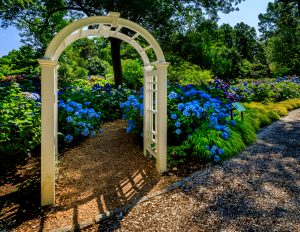
Heritage Museums and Gardens in Sandwich is the Cape’s largest public garden, sprawling 100 acres of groomed forest and coastal flora. In the spring, the property blooms with color thanks to its thousands of Dexter rhododendrons, which are celebrated during the Annual Rhododendron Festival in May. Come summer, the iconic Cape Cod flower, hydrangeas, takes center stage; the gardens feature over 155 varieties.
The property stays vibrant with events throughout the year, with a heavy focus on the summer months. Highlights include the Annual Auto Show in June and the July Hydrangea Festival. Families will enjoy the meandering walking trails and the hand-carved 1908 Looff Carousel. The gardens quiet down in the winter, except during the popular Gardens Aglow event that covers the landscape in thousands of colorful lights for the holiday season.
New England Botanic Garden at Tower Hill
11 French Drive, Boylston, MA | nebg.org
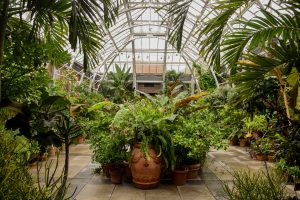
The state’s largest botanical garden, New England Botanic Garden at Tower Hill, stretches 171 acres in Boylston. The garden has 18 very different spaces that range from the walled Secret Garden, which is exactly what it sounds like, complete with calla lilies and perennials in a hidden rain garden, to the Ramble, a whimsical woodland with a stumpery, a Curiosity Cottage, and a waterfall.
The garden is open year-round thanks to its glass-enclosed conservatories: the Orangerie, where balmy temperatures shelter giant vines and seven historic Versailles boxes filled with tropical blooms, and the Limonaia, which has a cooler climate for its camellia collection. There are also a variety of citrus trees, and outside Pliny’s Orchard has a large collection of pre-20th-century heirloom apples. This summer, the landscape will come to life with the “Glass in Flight” exhibition, which features massive glass-and-steel sculptures of glittering pollinators scattered throughout the gardens.
Garden in the Woods
180 Hemenway Road, Framingham, MA | nativeplanttrust.org
Serving as the 45-acre headquarters for the Native Plant Trust, Garden in the Woods is a living museum of the Northeast’s wild flora. With its ridges and hollows, the garden is fun to explore and features over 1,000 native species, including many rare and endangered species. Visitors can walk the main path, a mile-long loop under a canopy of maples and oaks, or choose the Sand Plain, where drought-tolerant plants are on display. This garden is meant to preserve the plants that make New England unique while also inspiring visitors to bring ideas to their own backyards. There are events and workshops throughout the year, including Container Gardening to Nature Journaling.
Berkshire Botanical Garden
5 West Stockbridge Road, Stockbridge, MA | berkshirebotanical.org
Created in 1934, the Berkshire Botanical Garden is one of the oldest and most intimate public gardens in the country. Rooted in the heart of the Berkshires, there are 24 acres to explore from the Daylily Walk and raised bed gardens to the Children’s Discovery Garden and more contemplative Pond Garden. The goal of the garden is to celebrate New England plants while inspiring individuals to find success and joy in gardening. Throughout the year, they host educational programs.
There’s a strong arts focus here, too. Inside the Center House, a restored 18th-century farmhouse, is the Leonhardt Galleries. This space has a year-round rotation of nature-inspired exhibitions. It’s a great stop for those traveling to Stockbridge or other parts of Western Massachusetts.
Rhode Island
Roger Williams Park Botanical Center
1 Floral Avenue, Providence, RI | providenceri.gov/botanical
Looking for palm trees in New England? Look no further than the Roger Williams Park Botanical Center in Providence, the largest indoor public garden in the region. The glass conservatory stands 40 feet tall and can accommodate large indoor trees such as palm trees and other tropical plants. The Mediterranean Room is filled with carnivorous plants, towering cacti, and even water features. The Flavor Lab, where edible plants are grown, is also a gathering place for families because it’s stocked with toys, books, and a play area. In the warmer months, visitors can stroll through a rose maze and pollinator meadow. The garden staff follows a no-chemical approach, and the gardeners focus on soil health more than on plants. Instead of pesticides, they let their goats graze the property to remove invasive plants.
Green Animals Topiary Garden
380 Corys Lane, Portsmouth, RI | newportmansions.org
Looking for palm trees in New England? Look no further than the Roger Williams Park Botanical Center in Providence, the largest indoor public garden in the region. The glass conservatory stands 40 feet tall and can accommodate large indoor trees such as palm trees and other tropical plants. The Mediterranean Room is filled with carnivorous plants, towering cacti, and even water features. The Flavor Lab, where edible plants are grown, is also a gathering place for families because it’s stocked with toys, books, and a play area. In the warmer months, visitors can stroll through a rose maze and pollinator meadow. The garden staff follows a no-chemical approach, and the gardeners focus on soil health more than on plants. Instead of pesticides, they let their goats graze the property to remove invasive plants.
Connecticut
Elizabeth Park
1561 Asylum Avenue, West Hartford, CT | elizabethparkct.org
Elizabeth Park’s rose garden opened in West Hartford in 1904 and is the first municipally operated rose garden in the country (and today the third largest). The 2.5-acre garden has over 15,000 bushes and 800 varieties of roses. By June and into early July, the arches are completely covered in climbing roses that bloom only once a year, creating a romantic walkway for visitors.
Bartlett Arboretum and Gardens
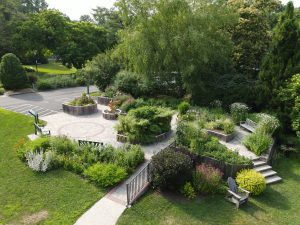
151 Brookdale Road, Stamford, CT | bartlettarboretum.org
Elizabeth Park’s rose garden opened in West Hartford in 1904 and is the first municipally operated rose garden in the country (and today the third largest). The 2.5-acre garden has over 15,000 bushes and 800 varieties of roses. By June and into early July, the arches are completely covered in climbing roses that bloom only once a year, creating a romantic walkway for visitors.