New England, as one of the most heavily forested regions in the United States, is ideal for the mindful practice of forest bathing.
By Lisa Cavanaugh
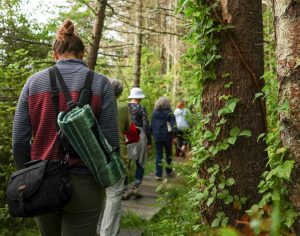
One lovely day last summer, I found myself communicating with a pine sapling. I was taking part in a forest bathing excursion in the woods of Yarmouth Port, Massachusetts, and our guide had asked us to step off the path and find a spot to focus on, engaging all our senses.
So, I paid acute attention to the songbirds, the slight breeze, and the smell of the sandy soil. I ended up gazing at a tiny tree and imagining its future. I touched its tapering, flexible needles, thought how it would outlive me, and then wished it well.
“That kind of imaginal element is what I love about forest bathing,” says Nev Hoffman, a certified forest therapy guide who runs Blue Fern Forest Bathing in Maine. “If you spend time in nature, you form a deeper relationship with it,” she says, explaining that guided forest therapy—a sensory immersion in a natural environment—is a research-based wellness practice, growing in popularity.
Numerous cultures have long valued time spent with nature, but forest bathing, as it is practiced today, was more formally developed in Japan in the early 1980s. Known as “shinrin-yoku,” it eventually became part of that country’s national health program.
Hoffman, a professional photographer for 25 years, found herself experiencing undue stress during the early part of the pandemic. “So I decided to go out into the woods,” she says. “Within 10 minutes, my heart rate returned to normal, and I felt a sense of well-being. I mentioned it to a friend, who said I was ‘forest bathing.’ I had never heard the term before.”
Intrigued, Hoffman did some research and eventually earned a certificate from The Forest Therapy School, which is internationally accredited by the International Mindfulness and Meditation Alliance (IMMA) and the Continuing Professional Development (CPD) Certification Services.
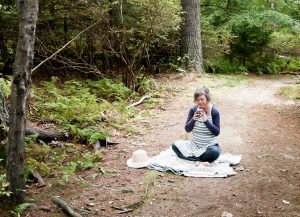
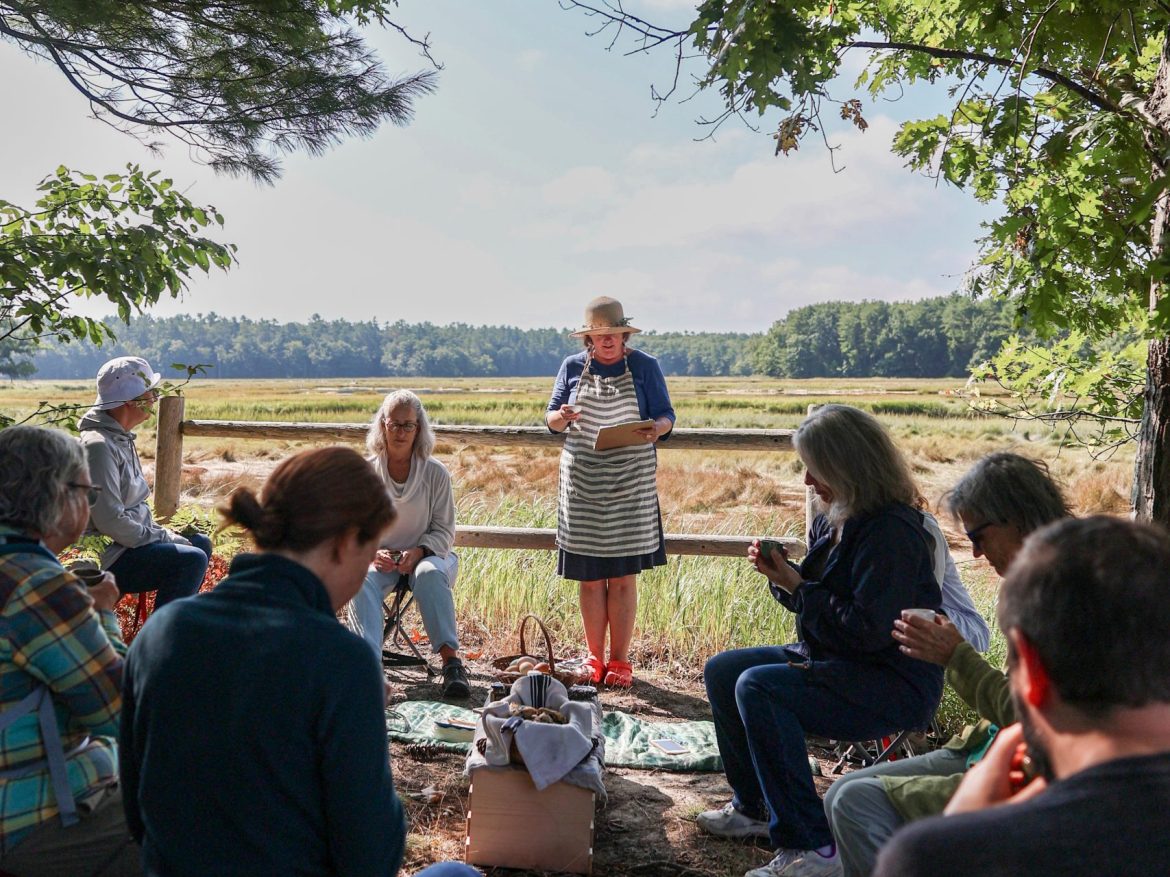
Hoffman leads about 12 public forest-bathing walks a year. She works primarily with the York Land Trust and the Kittery Land Trust (both in Maine), and with Bedrock Gardens in New Hampshire. Her walks usually last 2 to 3 hours, and she sometimes includes tea ceremonies or beach sessions. “I encourage people to sit and notice that their mind is trying to take over and then drop back in as a human body.”
A different challenge brought another certified guide, Nadine Mazzola, to forest bathing. The Massachusetts resident went through treatment for breast cancer in 2013 and 2014, and when the process of infusions and radiation was finally over, she wondered how best to continue focusing on her health.
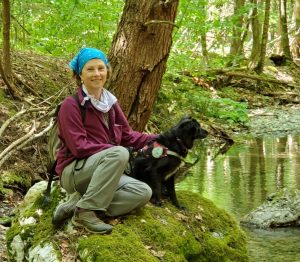
After overhearing a chance conversation about forest bathing, Mazzola found an Oprah Magazine article that discussed some of the practice’s immune-boosting benefits. “That really caught my attention,” she says. A few years prior, Mazzola had gotten a new dog, and they started walking every day on local trails. “I had this visceral reaction of ‘oh my gosh, what have I been missing all these years? I felt such a sense of beauty and joy being under the forest canopy.”
She discovered she could train to become a certified forest therapy guide through the Association of Nature and Forest Therapy (ANFT). “I felt this tug of needing to do this,” she says, and has been offering guided forest therapy walks in the Metro West Boston area since 2015. She works with the New England Botanic Garden, guides walks for the Massachusetts Horticultural Society in Dover and hosts a continuing education workshop that’s certified by Massachusetts General Hospital.
“Forest therapy acts as a valuable adjunct to standard treatment and rehabilitation,” notes Mazzola. “There is strong evidence that it reduces anxiety and depression and fosters a sense of belonging. It can lower cortisol, restore attention, and activate our relaxation responses,” she says.
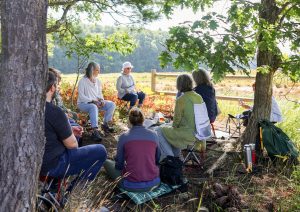
Mazzola also wrote an award-winning book called Forest Bathing with Your Dog. “It’s not a slow, immersive forest-bathing session; the goal is to be in the experience of the walk with your dog, pause when they pause, and notice how and what they notice.”
“Notice is definitely a word we use a lot in forest bathing,” Hoffman says. “You begin to notice patterns, textures, movement, and small details you may have walked past a thousand times before.” She likens the experience to that of a curious ant, exploring everything it encounters. ” Forest bathing gives you permission to slow down and spend time with what is right in front of you.”
Being like an ant or a dog in the woods can surely bring you a deeper connection with the natural environment, as I experienced in my chat with the fledgling pine.
“That is a great example of a relational element,” says Mazzola, explaining that the ANFT Relational Forest Therapy model uses that method of focusing on the aspect of being in relationship with the land. “There’s a sense of belonging to all the other things on this planet that can emerge when you are forest bathing,” she continues. “And while we tend to the planet, we’re attending to ourselves as well.”
That might ultimately be one of the most appealing benefits of forest bathing: a deep sense of personal well-being. “Participants often tell me they feel more relaxed, grounded, creative, and at ease by the end of a session,” says Hoffman. “It’s a simple practice, but it can be surprisingly powerful.”
Even with these noted advantages, Hoffman acknowledges that the concept of forest bathing can be a leap for some people. “I remind people that this kind of slow, attentive time outdoors is not new,” she says. “For most of human history, we lived in a much closer relationship with the natural world. Forest bathing gives us a way to return to slowness, wandering, and a rhythm many of us are missing.”