
On beaches from Maine to Massachusetts, artists transform marine debris into sculptures while conservationists turn the data into change.
By Kelly Chase
Empty plastic bottles and used straws, derelict fishing gear, Styrofoam takeout containers, bottle caps and lighters, deflated balloons, pool noodles: this list may sound like a miscellany of trash, but to a marine debris artist, it is a treasure trove.
The Center for Coastal Studies in Provincetown, Massachusetts, organizes local beach cleanups year-round. Some of the marine debris is brought back to the facility and stored in bins and bags. Artists from around New England come to browse the collection and take what inspires them.
One rainy afternoon, Cindy Pease Roe, a Connecticut-based marine debris artist, wades through piles of trash from a recent beach cleanup. Laura Ludwig, director of the marine debris and art program at the Center for Coastal Studies, has told her to help herself. “I feel like someone just gave me their credit card,” says Roe, as she stows rope, buoys, and even a boat seat.
When Trash Becomes Medium
Roe says she was always an artist and a beachcomber. She combined the two passions about 15 years ago, when she began questioning the debris washing up on her local beach. “I was walking along the shoreline, and I saw a tremendous amount of plastic, and I started asking, ‘Where is all of this stuff coming from?’” says Roe. As she searched for answers, she began incorporating her discoveries into her work. “I would just spend a lot of time sculpting and playing around with the materials, and then the materials started presenting themselves in really different ways,” says Roe. “I would find a degraded tarp, and I would think, ‘Wow, this looks like the skin of a blue whale.’”
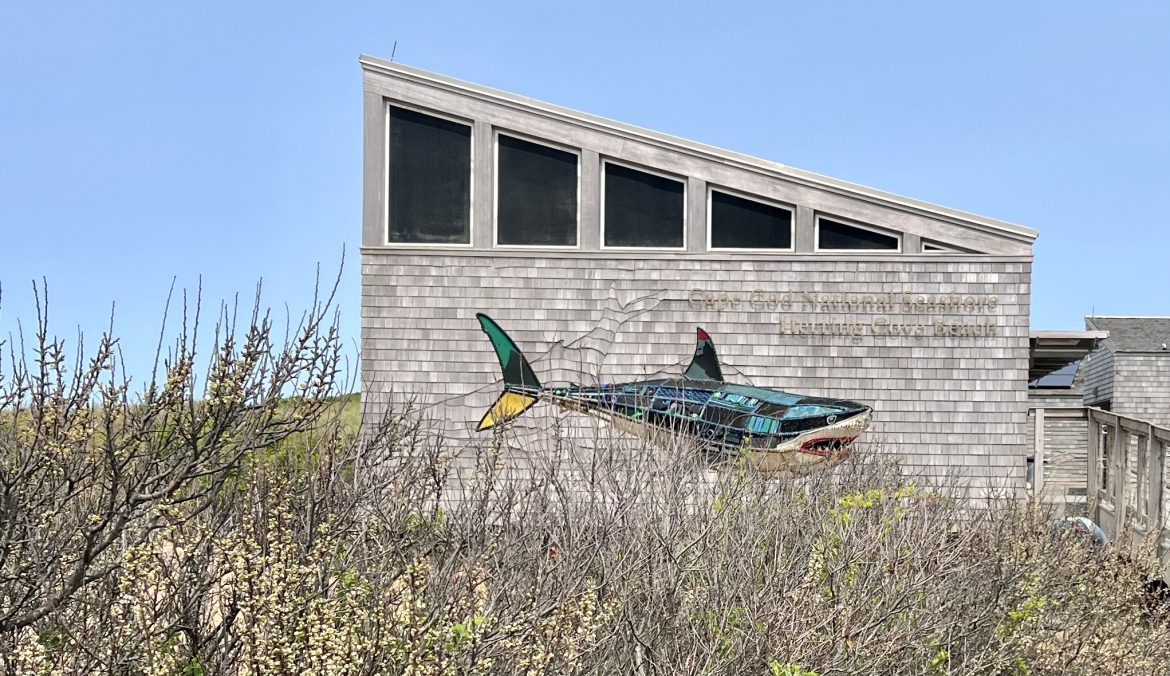
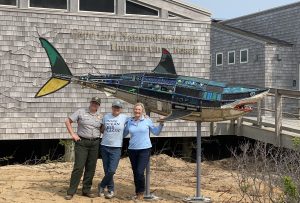
Roe’s pivot to debris proved fruitful, and she began catching the attention of local organizations. In the summer of 2025, she was commissioned by the National Park Service to create a marine debris sculpture for the Cape Cod National Seashore. The result is “Mama Shug,” a 14-foot sculpture of a white shark outside Herring Cove Beach.
From afar, the predator’s form is obvious, but when viewers get closer, they see what she’s really made of: her teeth are the tips of beach umbrellas, her eyes are swim goggles, her nose is marked by one lost sneaker, and her body is wrapped in layers of single-use plastics and abandoned fishing gear. A nearby sign further illuminates the artist’s medium, it reads “100 percent unnatural materials,” all of which were hauled off Cape Cod beaches.
“Everything I do has a message about educating people—it’s not just, ‘Here’s the work’; it’s ‘Look at what it’s made out of, and now, what can you do about it?’ Sometimes you need to see a white shark made from plastics picked up off the beach to say, ‘Oh, my God. I had no idea,’” says Roe. “I want people to look at their habits, see these everyday objects, ask how they got into the ocean—and figure out how we can all make a difference in our own communities.”
Conversations on Consumerism
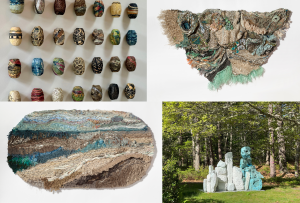
Other sculptures around New England share Mama Shug’s mission. “Glacial Ghost,” by Mosh Studio artists Suzanne Moseley and Adrienne Shishko, stood on Brookline’s Riverway Park. The sculpture looks like blocks of ice from a distance, but on closer inspection, the true material, Styrofoam, is revealed.
Styrofoam, or polystyrene, often found beneath docks, in packages, or safeguarding takeout, is toxic to marine life because it doesn’t biodegrade. “Polystyrene doesn’t go away, it just breaks down into smaller pieces,” says Shishko, which makes it easier for fish and other marine life to ingest the toxic material. Then, she says, humans consume the fish.
Like Roe, Moseley and Shishko gather some of their materials from the Center for Coastal Studies. They worked with Styrofoam because they were inspired by a large beach cleanup that took place on the Boston Harbor Islands in 2024. Eighty volunteers extracted 40,997 pounds of debris, and close to 3,000 pounds of Styrofoam. “Styrofoam doesn’t really weigh anything, and they had [2,843] pounds of it and it was entangled in wildlife habitats and decaying on beaches,” says Moseley.
Moseley and Shishko have been sparking conversations about waste and consumerism through their art for years. They found their way into marine debris during a residency with Farm Projects in Wellfleet, Massachusetts. “As we’ve done with all of our work, we try to create something that visually intrigues people,” says Shishko. “They say, ‘Oh, that’s beautiful, or that’s interesting. I want to come closer and understand this.’ And only on deeper viewing and reflection do they then start to recognize the underlying concerns.”
“Buoy Relics” is another sculpture by the duo that looks like a compilation of excavated artifacts from an archaeological dig. The reality is that they are plastic buoys that once marked a swimming lane. “It was based on this idea that this stuff takes three or four hundred years before it degrades,” says Moseley. “This is what the people who come next are going to be finding and studying about our culture.”
Evidence at the Water’s Edge
While the marine debris artist works with trash to create visual conversation starters about pollution in our coastal habitats, Laura Ludwig’s oeuvre is numbers and spreadsheets. She tracks everything she and her team bring in from the shore. Over the past 12 years, the Center for Coastal Studies has been working with commercial fishermen to recover lost gear from the ocean floor. Since 2013, the group has pulled up about 202,000 pounds of gear, consisting largely of traps and rope.
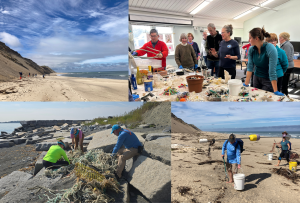
On the shoreline, the organization runs annual beach cleanups. In 2024, close to 100,000 pieces of debris were picked up off Massachusetts’ beaches, including 14,000 coffee cups, 12,000 pieces of microplastics, 6,500 fragments of Styrofoam, 4,028 bottle caps, and 2,833 balloons and balloon strings. Ludwig’s goal is to translate those findings into action. “If you are just collecting trash for the sake of collecting trash then that’s great because it gets it out of the ocean and off the beach,” she says. “But if we can isolate it by debris type then you are able to tell a story of its presence, its persistence, its occurrence rate, and sometimes its source.”
She cites single-use plastic water bottles, which accounted for most of the organization’s debris in the early 2010s. Several Cape towns used Center for Coastal Studies data to draft bylaws limiting single-use plastic water bottles. (Although she says that now the data points to the use of more plastic sports drink water bottles instead.) In 2018, Chatham referenced the center’s data to pass a bylaw limiting the sale of helium-filled balloons, and in 2019, Provincetown relied on it to craft bylaws limiting plastic straws and polystyrene.
“Systemic changes like these have to be our goal at this point,” says Ludwig. Inspiring consumers to examine their habits is good, but the root of the problem is what she’s after. “There needs to be extended producer responsibility at every turn,” say Ludwig. “Anybody who makes something plastic needs to have then an idea of how to get rid of it. They can’t just put that on the consumer anymore.”
Ludwig believes that art is just another vehicle for raising awareness of marine debris issues. “Art has this ability to communicate with people, particularly people who aren’t necessarily data-driven in a different way, where there’s a big image or a big concept that’s reflected that makes it more accessible.”
Attention as Activism
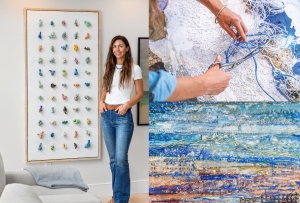
Jackie Ranney is a marine debris artist who sees the importance of involving the local community as well. She has worked with her local school system in Hull, Massachusetts, to create programs for kids. “We do a beach cleanup and then we create art from what we find,” says Ranney. At first, the older kids weren’t overly intrigued, but then they became surprised by and concerned with some of the trash they found on their town’s beaches. “They got really into it and started creating sea creatures,” says Ranney. “Getting kids thinking about this is a powerful tool. I think it can set us on the right path.”
Ranney partially owes her dive into marine debris art to her son. She had made it a habit to clean up trash on her morning beach walks. She was a fine artist by profession, but she began hitting a wall. “I kept asking myself, ‘Why am I doing this? Why am I making another, hopefully, pretty piece of artwork for a wall?’” she says. “That question was haunting me.”
One winter day on Nantasket Beach, her then toddler-aged son stopped to marvel at a piece of fiberglass. “He was like, ‘Look at this piece.’ He was amazed, and I held it in my hand, and I was like, ‘Oh, wow.’ I saw what he saw. I put it in my pocket, and I started thinking about it.” When she got home, Ranney announced to her family that she was going to start making art from trash. “They were a little confused, but they were also very supportive,” Ranney says with a laugh. “My initial pieces were, well, trash,” she says. “But it was something I had to push through, and it felt right in my heart because I was doing something that was very meaningful to me.”
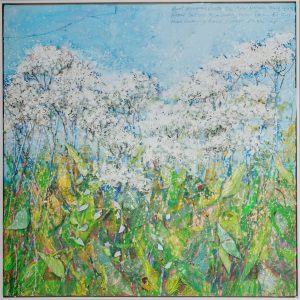
Today, Ranney’s art has become meaningful to many others. She works with collected debris and upcycled paint, and each work is a new and rewarding challenge. In some compositions, she uses discarded rope knots from the fishing lines to create a grid in the center of her canvases. In one of her lush gardenscapes, which is vibrant and full of movement, viewers that the large strokes of texture and color are from the most surprising items: fake leaves, an asphalt shingle, and even pool noodles.
If not for her materials list, most wouldn’t know that everything on her canvases is recycled. “It becomes almost like a ‘Where’s Waldo’ game, and they look for everything in my paintings, so that gets people engaged and helps people to talk about it,” she says. “I feel that the people who buy my work are proud to show it to other people because of the element of surprise, but also because they care about the condition of the ocean.”
Ranney is betting on the power of the frequency illusion: Once we become aware of a problem, we can’t unsee it. “A lot of times we kind of have blinders on. You can go for a walk on the beach and never pick up anything and never even notice any trash, but once you’re made aware of it, all a sudden your eyes start zoning in on and finding things.”
She hopes this sparks involvement: maybe someone will pick up what they see and dispose of it, or maybe they’ll participate in a local cleanup. “I really want to create beautiful pieces that inspire a love of place because when we love a place and when we find beauty in it, we want to protect it,” says Ranney.
Large Sculptures, Large Messages
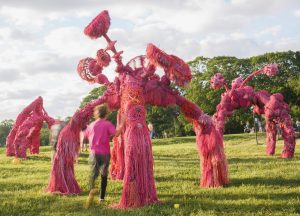
Pamela Moulton is a Maine-based marine debris artist who works with the Gulf of Maine Lobster Foundation. Moulton uses salvaged ocean gear, such as rope and traps, for her sculptures, which can weigh more than a ton and often require a crane for installation. “These are big outdoor works, so they have to be really treated, weather-coated, and solid,” says Moulton. “I also want them to be very immersive for people—I want them to walk through them or under them—and offer an element of surprise when they realize what it’s made out of.”
“Tangle,” which looks like a five-legged sea creature stands guard on the lawn of the University of Southern Maine’s Portland campus. Weighing in at over a ton, it’s a jumble of nets and ropes all collected from the local waterfront. “At first glance, these sculptures are joyful, colorful, and playful. I think they’re like magnets for people, and especially kids,” says Moulton. “Then the greater message is about the environment, because they get up close and they realize that all of this stuff was in the ocean.”
Due to the sheer scale of her work, Moulton often relies on volunteers. In the summer of 2025, she worked on a sculpture in Moakley Park in South Boston. She enlisted the support of volunteers who were timid at first. “But word spread, and the next week when I went down there were more and more people,” says Moulton. She says that over time, neighbors brought grills and played music; they were so involved in the making of the piece that she had everyone sign their names to the sculpture. “That project was really special,” she says. “They really mobilized the whole neighborhood.”