Two nonprofits have scattered cozy waypoints throughout the winter woods.
By Kelly Chase
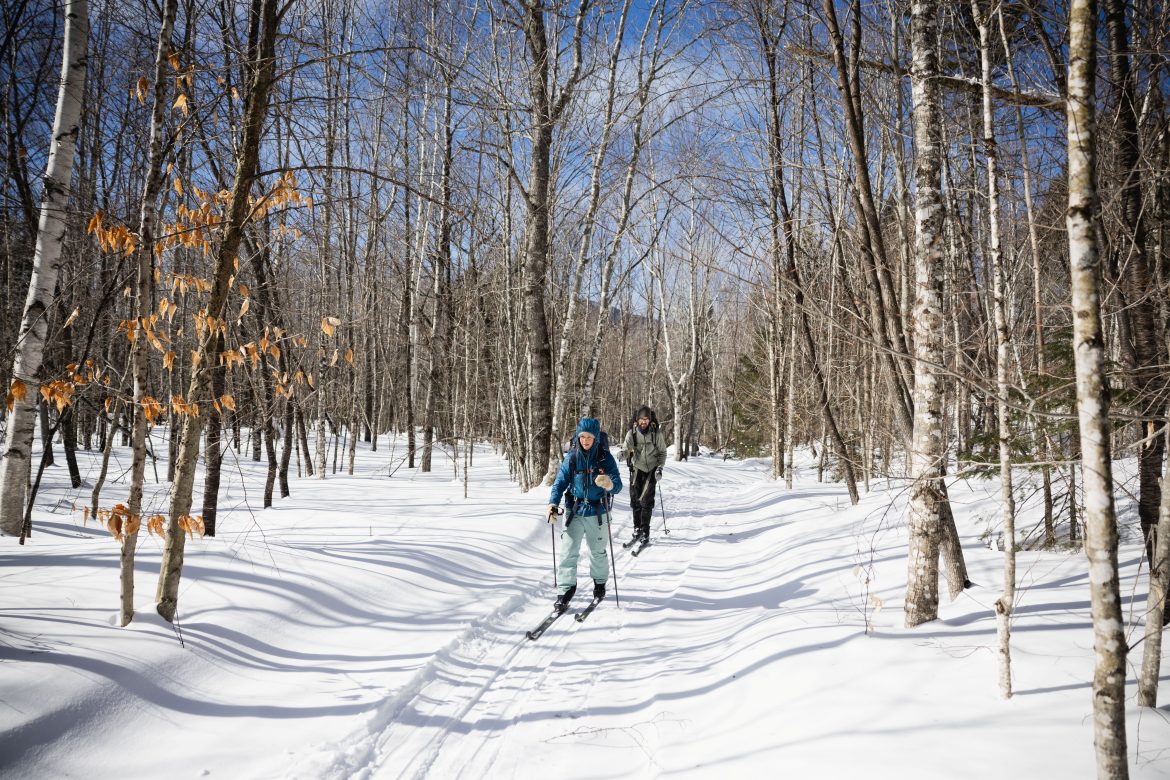
New Englanders know you can’t wait for the perfect forecast to do the thing you love. Winter can make the pull to the outdoors a little more complicated, but two local nonprofits prove that the effort is worth it: a snow-covered forest, a quiet trek on snowshoes or skis, and a cozy cabin to greet you at the end.
Maine Huts & Trails and Vermont Huts & Trails have stitched together access and comfort into the backcountry of their respective states, turning winter woods into places you can stay awhile, not just pass through.
Western Maine’s ecolodges: trails, meals, and community
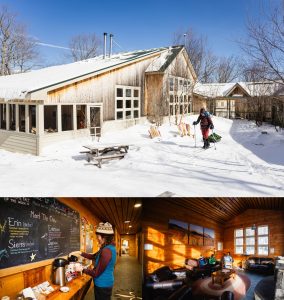
Maine Huts & Trails operates four ecolodges in the Western Lakes and Peaks region of the state. (One lodge is currently closed due to necessary maintenance, but there are plans to reopen it next year.) The lodges are all connected by a system of trails spanning anywhere from seven to eight miles. The lodges are remote, and visitors park at one of the designated lots and make their own way through the woods along a well-marked, groomed trail. In the summertime, you can hike to the lodges, but in the winter, you have to strap on cross-country skis, snowshoes, or hop on a fat-tire bike. When you arrive at the hut, it’s a beacon of coziness. “After seven miles on a trail, you get to the lodge and the wood stove is going, there’s a comfortable couch, you can grab a cup of coffee or a Maine beer and settle in,” says Erika Johnson, marketing director for Maine Huts & Trails. “It’s a good feeling, and one that you can’t really know and appreciate until you experience it for yourself.”
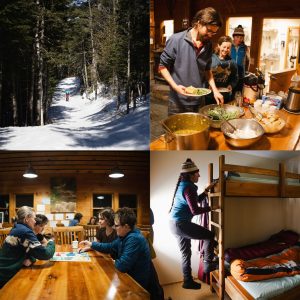
The lodges are communal and can sleep between 44 and 48 people. Each reservation includes a private room for guests. “We call them huts, but they are really ecolodges,” says Johnson. “I think most people are surprised when they arrive because they are these beautiful two-story lodges in the woods with radiant floor heating and modern composting toilets, and they’re really clean.” The main area of the cabin has a wood stove, sitting areas, tables, and games. Johnson says it’s where most people gravitate. “It’s a very friendly, community-style atmosphere,” she says. “There are day visitors stopping in to refill their water bottles or to have some coffee. For those who are staying, they are typically tired from the trek and find a spot near the fire. Everyone mellows out and unplugs.”
During the winter, Maine Huts & Trails has two offerings: on the weekends (Thursday through Sunday), the lodges are fully staffed, and the staff provides three meals: breakfast, dinner, and a packable lunch. “We accommodate pretty much every dietary restriction, and you get hearty meals, not just pasta and meatballs,” she says. “The staff makes stews and chicken, and we serve everything family-style, and there are always leftovers.”
During the organization’s annual Alpine Feast, the food is anything but camp cuisine. “Big Tree Catering out of Portland comes up and they set up food stations at Stratton Brook,” she says. “There are freshly shucked oysters, homemade bao buns, a beer sponsor—it’s a big food party.” During the week (Monday through Wednesday), guests are required to bring their own supplies. “Those are our self-service days, so you bring your own food and cook it in our kitchen,” she says. “You still have access to all the amenities, and someone from our staff is always on site.”
The weather hardly ever impacts the experience. “We are hoping for snow here,” says Johnson. “I think the only time we’ve closed the huts is when we had a negative 47-degree windchill.”
While some visitors opt to do the whole three- or four-hut hike, which ends with a shuttle back to your car, others book just one or two huts and explore the surrounding areas. “People tow kids in sleds, photographers tow their gear, some people do one hut, and others visit all of them,” says Johnson. “You can really create your own adventure.”
Private huts throughout Vermont’s woods
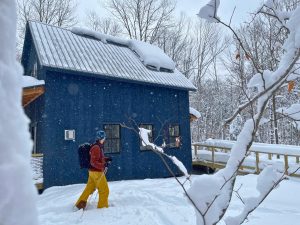
In its ninth year, Vermont Huts and Trails operate 17 remote huts. The organization owns some, and others are privately owned. The trails are not directly connected yet (plans are in place for a through-route), but they are all connected to local trail systems built for hiking and mountain biking in the warmer months, and snowshoeing and cross-country skiing when the snow falls. “It’s a really wonderful thing to be on a bike or on snowshoes and feel a little removed from civilization for a bit,” says Matt Ogelby, marketing director of Vermont Huts and Trails. “Folks who stay with us have found it as rewarding and amazing as we hoped.”
Each booking is for your group only, so no sharing is necessary. In winter, many of the huts are not roadside, so expect a short ski or snowshoe through the woods. Huts range in size, but many sleep between four and ten people, and, Ogelby says, oftentimes they are more affordable than staying at a hotel or a rental. Visitors will need to bring in the food they plan to eat, water, and their sleeping bags. Every hut is equipped with propane, kitchens, firewood, and wood stoves. All the kitchens are stocked with cooking essentials. “You really do just need food, clothes, and a sleeping bag,” he says.
Vermont’s huts are spread across the state, with seven clustered around Burlington and Huntington. The Chittenden Brook Hut sits in a semi-remote Green Mountain National Forest campground; in winter, it’s a quiet two-mile snowshoe from the road and just steps from the Velomont and Long trails and managed backcountry-ski zones. In Huntington, the Butternut Cabin is anchored on the Sleepy Hollow trail network, known for its groomed cross-country ski trails. “Each hut offers its own experience and its own recreational opportunities,” says Ogelby. “Some sit near busier trails, where others are quieter and more secluded for people who just want to spend that time in nature.”
The huts are open for winter and summer use, and Ogelby says it is an experience that you can tailor to your style and desires. Whether you are looking to trail ride in the summer or snowshoe in the winter, he says the organization just wants to get you out there. “We want people to experience the huts and the woods because we know that when people care about something, they care for it,” he says. He adds that most people know it’s good for them to spend time outside in any season. “There’s a lot of research that shows that access to outdoor recreation brings joy and helps us connect with each other and the environment,” he says.
A Wider Welcome to Maine’s Woods
Maine Huts & Trails is a nonprofit organization whose mission is to inspire a love for the outdoors, particularly the Western woods, lakes, and peaks of Maine. In the summer, the organization hosts the Youth and Community Experience Fund, where they invite kids from communities that don’t readily have access to the outdoors or these types of experiences at their fingertips. “Kids should get to experience this part of the state too,” she says. “I think everyone is overwhelmed by technology, but especially kids, so it’s nice for them to get out on the trails, see the sun rise, and recharge.”
Opening the Backcountry to Everyone
F.O.R.E.S.T. (Fostering, Recreation, Education, Sustainability, and Teamwork) is Vermont Huts & Trails community-driven program. “We work with a forest educator and invite historically marginalized groups, or folks who face barriers to the outdoors, into the backcountry free of charge,” says Ogelby. The forest educator teaches about the trails, woods, and the environment. “It’s all about opening up the outdoor space to everyone, and this program is something we are really proud of,” he says.