From a youth field in Massachusetts to sold-out stadiums, Jesse Cole rebuilt baseball around joy, and millions of fans showed up.
By Kelly Chase
Photography by The Savannah Bananas / Ansley White
Before the sold-out stadiums and viral social media clips, Jesse Cole’s favorite baseball memories were made at Greenbush, a youth field in Scituate, Massachusetts. He remembers boom boxes on the sidelines, coaches (his dad included) keeping things loose, and long summer days when baseball was more about fun than fundamentals.
Today, Cole is the owner of the Savannah Bananas, a professional baseball entertainment team, and the founder of Fans First Entertainment, but those early memories still shape how he thinks about the game. “We had a group of guys, a group of teammates, and that’s what it was all about,” says Cole. “That was my summer, it was playing the game every day, and the game was supposed to be fun.”
The philosophy that baseball should feel joyful, shared, and a little loose became the foundation behind his now-famous game, Banana Ball. For the 2026 season alone, his league is projected to draw roughly 3.4 million fans. “It’s crazy, and I think it shows that these days everyone is hungry for fun,” says Cole. “Banana Ball is an opportunity to not take yourself too seriously, to dance, to sing, to let loose, and just have fun.”
The Dream
Yet, owning an entertainment league and changing the sport Cole grew up loving wasn’t the path he had in mind. During college, he was a real prospect and received letters from major league teams like the Braves and the Pirates. “I was getting Christmas cards from the New York Mets, and I was like, ‘All right, I have a chance to get drafted here, that’s where my life is going to go,’” he says. “Then my senior year, I tore my shoulder.”
When his shoulder never fully recovered, the interest from major league teams stopped. Suddenly, this die-hard baseball player found himself unmoored, unsure of what came next. “I played baseball, that’s what I did, that was my whole life,” he says. “I had no idea what I was going to do when it ended.”
After a summer coaching stint in the Cape Cod Baseball League, he traveled south to take a job as general manager of the Gastonia Grizzlies, a collegiate summer baseball team in the Coastal Plain League (CPL). It sounded like a big offer for a 23-year-old, but in reality, Cole walked into a mess: the team had little money, sparse crowds, and an average attendance of 200 fans a game. “We were the worst performing team in the entire country,” he says.
Cole’s competitive spirit reawakened, and his wheels began to turn on how he could get more people into the stadium. Instead of studying Theo Epstein and Billy Beane, he studied legendary entertainers like Walt Disney and P.T. Barnum. He implemented funny and wild promotions like Grandma Beauty Pageants and Salute to Underwear Night. Ticket prices stayed reasonable, included food and drinks, and never had hidden fees. “We started making it all about entertainment,” he says. “We started climbing in attendance, and eventually we were fourth in the country in attendance.”
Cole’s bet that baseball could be more theatrical and less “Moneyball” was working. “I realized that, to be successful, we couldn’t and wouldn’t be the best baseball team, but we could be the most entertaining one,” he says.
Building Banana Ball
After Gastonia, Cole and his wife, Emily, purchased their own team in the CPL in Savannah, Georgia, eventually naming it the Savannah Bananas. The idea for Banana Ball continued to take shape in Cole’s mind. He had mastered bringing spectacle to the stands, but he had yet to touch the game itself. That changed in a conversation he had with his dad. Cole succeeded in filling the stadium, but he noticed that by the seventh inning of almost every game, people were leaving. “I said to my dad, I think the game is just too long,” he remembers. “My dad said, ‘Jesse, what if every inning was match play and whoever won the inning got the point?’ and I said, ‘That’s not a bad idea, Dad.’”
Cole brought the idea to his head coach and a small group of his staff. They liked it, and together they sketched out even more rules of a new, faster-paced game. Those rules have since become the DNA of Banana Ball. Some are pure theater, some are pace-of-play fixes, and all of them are aimed at adding a dash of showmanship and fan participation. For example, if a fan catches a foul ball, it’s an out; batters are not allowed to step out of the box; no walks allowed; and mound visits are strictly prohibited. “I don’t think I have ever heard anyone say, ‘I hope this game has a lot of really long mound visits,’” he says.
The Banana Ball game fans see today took years to build. The Savannah Bananas continued to play in the summer collegiate league all while testing Banana Ball games on the side—first in controlled experiments through 2018, then in front of fans during the first official game in 2020.
Banana Ball games began to sell out. In 2021, the team took its first road trip to Alabama, and in 2022, they took Banana Ball to seven cities. The potential became obvious, and in 2023, the Savannah Bananas left the CPL to play Banana Ball full-time.
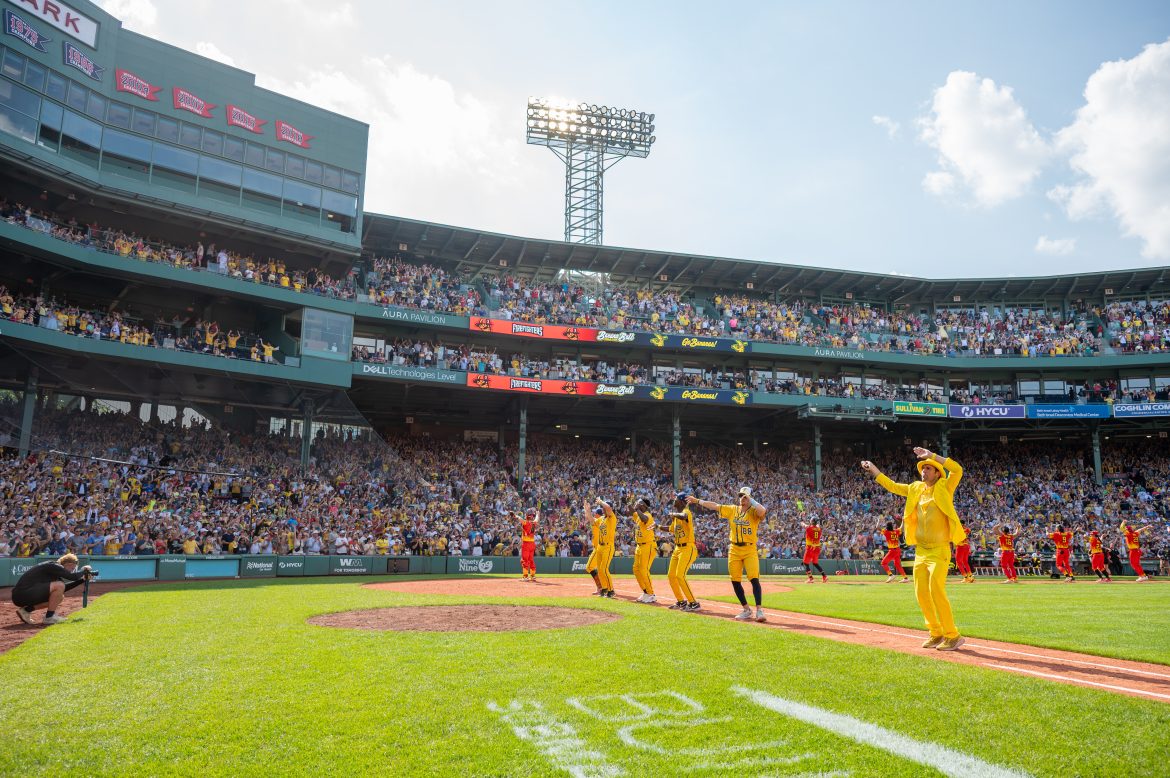
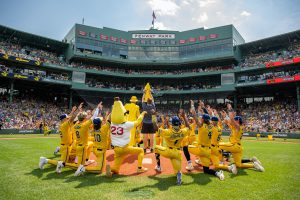
Within a year, the tour expanded to new cities, bigger stadiums, and multiple Banana Ball teams. By 2025, that included two sold-out games at Fenway. Returning to Massachusetts and seeing Fenway full for Banana Ball was “beyond emotional,” says Cole.
Lasting Impact
The scale of Banana Ball in 2026 is almost hard to grasp: stadiums that hold more than 100,000 fans, and another return to New England for two sold-out games at Gillette. For Cole, though, the growth still traces back to a lesson he learned early on while standing in the batter’s box. “My dad used to say, ‘Swing hard in case you hit it,’ and that mindset has really stuck with me in baseball and in life,” says Cole.
Cole’s message for younger players is simple: protect the fun. He knows how quickly the game can become about pressure and performance. But the feeling, he says, is what lasts. “People remember the moments that you’re out there having fun,” he says, “and when you’re having fun, you play better.”
For schedules and information, visit bananaball.com.